Peritoneal Dialysis (PD) Dropouts and Transitioning to Hemodialysis
New Course!
This course will provide an overview of current trends in the utilization of home dialysis modalities, with a special focus on understanding the factors contributing to peritoneal dialysis (PD) dropouts. Participants will examine common clinical, psychosocial, and system-level causes of PD discontinuation and gain insights into best practices for managing transitions from PD to hemodialysis (HD). The course will also discuss the integrated care model that supports seamless transitions from PD to home hemodialysis (HHD), highlighting strategies to optimize patient outcomes, preserve autonomy, and sustain long-term home dialysis success.





A Practical Approach to Sodium Management in Dialysis Patients
This course will review sodium balance and toxicity in dialysis patients, discuss the role of sodium (NA) according to the new understanding of physiology, explain sodium-water imbalances in dialysis patients, describe dietary approach and sodium management in Hemodialysis (HD) and peritoneal dialysis (PD) patients.
透析患者钠管理的实用方法
中文简介:在本课程中,我们将学习透析患者的钠平衡和钠中毒。根据对生理学的全新理解讨论钠(Na)的作用,解释透析患者的水钠失衡现象,描述血液透析(HD)和腹膜透析(PD)患者的钠管理,并回顾透析患者钠管理的饮食方法。#Chinese
투석 환자의 나트륨 관리에 대한 실제적 접근 #Korean
본 과정에서는 투석 환자의 나트륨 균형과 독성을 검토하고, 생리학의 새로운 이해에 따라 나트륨(NA)의 역할에 대해 논의하며, 투석 환자의 나트륨-수분 불균형에 대해 설명하고, 혈액투석(HD) 및 복막 투석(PD) 환자의 식이 요법 및 나트륨 관리에 대해 설명합니다.

Hemodialysis Vascular Access Cannulation
This course will provide an in-depth review on vascular access care and the recommended cannulation techniques. It will address the importance of access care and evaluation before cannulation, describe the most common cannulation-related complications and discuss measures to prevent these complications. #
혈액투석 혈관통로의 천자 #Korean
본 과정에서는 혈관통로 관리 및 권장되는 천자 방식에 대한 심층 검토를 제공합니다. 천자 실시 전 통로 관리 및 평가의 중요성을 다루고, 가장 일반적인 천자 관련 합병증에 대해 설명하며, 이러한 합병증을 예방하기 위한 조치에 대해 논의합니다.

Transitions in Care for Dialysis Patients
Dr. Leslie Wong provides a dynamic and comprehensive presentation on transitioning patients to home dialysis. In this recorded session, Dr. Wong will review important transition points in the care of dialysis patients, discuss practical aspects of Transitional Care Units (TCU), analyze patient outcomes from TCUs, and outline methods to screen and identify appropriate patients for home dialysis. He will also briefly discuss incremental start dialysis, urgent start dialysis, and transitioning from PD to HHD.

Transitioning from Peritoneal Dialysis to Home Hemodialysis
This course will provide an overview on Peritoneal Dialysis (PD) to Home Hemodialysis (HHD) transition pathways, potential reasons for PD technique failure, patient considerations on choosing HHD. It will highlight the importance of early modality education and the outcomes with a PD to HHD approach.
*This is currently available as non-CE course only.
Understanding Hyperphosphatemia and Mineral Bone Disorder
This course discusses the pathophysiology of Mineral Bone Disorder in chronic kidney disease (CKD) and reviews the roles of the major players in mineral bone homeostasis. The course also provides an introduction to the management and treatment approaches for this disorder. #Spanish
Learn about the 2017 Updates of the KDOQI Mineral and Bone Disorder Guidelines and stay up-to-date with topics related to MBD diagnosis, recommended phosphorus intake, goal phosphorus levels, goal PTH levels, and MBD in transplant patients. The key differences between the 2017 and 2009 guideline recommendations are highlighted in the short presentation. Full guideline document can be accessed at the end of the presentation or by clicking on the references icon. Click Here to start presentation.
If you have purchased CME credit(s) for this course, please click HERE to view the Learner Notification.
Good Nutritional Practices for Hemodialysis Patients
This course will provide an overview on nutritional disorders and challenges of hemodialysis patients. It will summarize nutritional monitoring & assessment with 5 key Nutritional Practices for dialysis patients. It will also discuss special recommendations for dialysis patients with diabetes.
血液透析患者良好的营养实践操作
中文简介:营养是患者治疗中的一个非常重要的环节,直接影响血液透析患者的健康和生活质量。但坚持推荐的营养实践指导通常关系到诸多限制因素,而这些限制因素会给患者、护理人员和/或家庭成员带来沉重的负担。通过本课程,可以了解血液透析患者的营养难题、血液透析患者的营养监测和评估指标、透析患者的5大关键营养实践操作和针对糖尿病患者的特殊建议。#Chinese
혈액투석 환자를 위한 바람직한 영양 관리 #Korean
본 과정에서는 혈액투석 환자의 영양 장애 및 문제에 대한 개요를 제공합니다. 투석 환자를 위한 5가지 주요 영양 수칙과 함께 영양 모니터링 및 평가를 요약합니다. 또한 당뇨병이 있는 투석 환자를 위한 특별 권장 사항에 대해서도 논의합니다.
Fluids, Electrolytes, Acids and Bases
This course provides a comprehensive overview on major components of body fluid, mechanisms of homeostasis and their impact on fluid movement. It will review acid/base chemistry and roles of electrolytes in normal body functions. It will also cover how these components are regulated by the kidneys, the possible causes, symptoms and treatment strategies of imbalances in patients with kidney disease.
수분, 전해질, 산 및 염기 #Korean
본 과정에서는 체액의 주요 구성 요소, 항상성의 기전 및 체액 이동에 미치는 영향에 대한 포괄적인 개요를 제공합니다. 산/염기 균형 및 정상적인 신체 기능에서 전해질의 역할을 검토합니다. 또한 이러한 구성 요소가 콩팥에 의해 어떻게 조절되는지, 콩팥병 환자의 불균형에 대한 가능한 원인, 증상 및 적용 가능한 치료 방법에 대해 다룰 것입니다.
The Kidneys in Health and Disease
This course will review renal anatomy and nephron structure, principles of renal physiology, Acute Kidney Injury (AKI) prevalence and classification, Chronic Kidney Disease (CKD) prevalence and classification.
콩팥의 건강과 질병 #Korean
본 과정에서는 콩팥의 해부학 및 네프론의 구조, 콩팥 생리학의 원리, 급성콩팥손상( AKI)의 유병률 및 분류, 만성콩팥병(CKD)의 유병률 및 분류에 관한 내용을 다룹니다.
Hypertension in Hemodialysis Patients
This course provides a comprehensive overview of the blood pressure (BP) management in hemodialysis patients. It reviews BP classification and the importance of appropriately monitoring patients with various methods for measuring BP. The diagnosis of hypertension and best practice recommendations for management and treatment for such patients are also discussed. Further, the course covers the potential causes and interventions for resistant and paradoxical hypertension during dialysis.
血液透析患者高血压 #Chinese
中文简介:本课程将全面介绍血液透析患者的血压管理。回顾血压的分类、准确监测患者血压的重要性,讨论血压监测的方法、血液透析患者血压控制的建议及可用治疗策略,及透析过程中难治性高血压和反常性高血压的可能病因及其治疗方案。
혈액투석 환자의 고혈압 #Korean
이 과정은 혈액투석 환자의 혈압(BP) 관리에 대한 포괄적인 개요를 제공합니다. BP 분류와 다양한 BP 측정 방법으로 환자를 적절하게 모니터링하는 것의 중요성을 검토합니다. 고혈압 진단과 환자의 관리 및 치료를 위해 권고되는 권장 사항도 논의됩니다. 또한 이 과정에서는 투석 중 저항성 및 역설적 고혈압에 대한 잠재적인 원인과 중재를 다룹니다.

Vascular Access in Hemodialysis
This course will discuss the importance of early patient education, explain risks, benefits and current trends for each type of vascular access. It will review basic principles of patient evaluation and discuss appropriate cannulation techniques and vascular access related complications. #Spanish
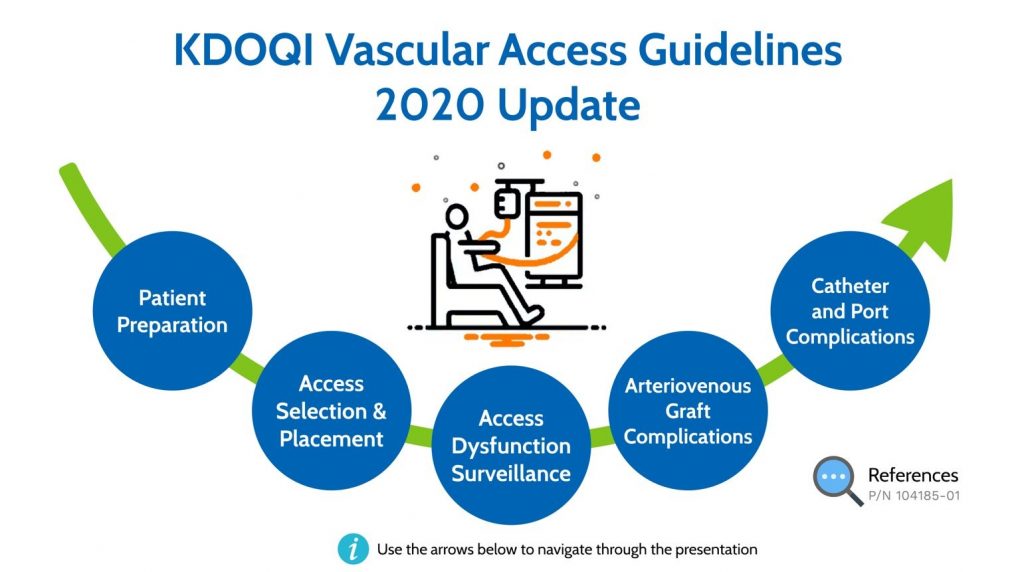
KDOQI Vascular Access Guidelines 2020 Update is available now! Click Here to start presentation.
Learn about the 2020 Updates of the KDOQI Vascular Access Guidelines and stay up-to-date with topics related to patient preparation, access selection & placement, access dysfunction surveillance, AVG complications and catheter complications. The key differences between the 2006 and 2020 guideline recommendations are highlighted in the short presentation. Full guideline document can be accessed at the end of the presentation or by clicking on the references icon.
혈액투석을 위한 혈관통로 #Korean
이 과정에서는 조기 환자 교육의 중요성에 대해 논의하고, 혈관통로의 각 유형에 대한 위험, 이점 및 현재 동향을 설명합니다. 환자 평가의 기본 원칙을 검토하고 적절한 천자 방법 및 혈관통로 관련 합병증에 대해 논의합니다.
KDOQI Vascular Access Guidelines 2020 Update 지금 이용하실 수 있습니다! 프레젠테이션을 시작하려면 여기를 클릭하십시오.
KDOQI 혈관통로 지침 2020 업데이트에 대해 알아보고 환자 준비, 통로 선택 및 배치, 통로 기능부전 감시, 인조혈관 합병증 및 카테터 합병증과 관련된 최신 정보를 받아보세요. 2006년과 2020년 지침 권고사항의 주요 차이점은 짧은 프레젠테이션에서 강조 표시되어 있습니다. 전체 지침 문서는 프레젠테이션을 마치거나 또는 참조 아이콘을 클릭하여 확인하실 수 있습니다.
Fluid Management in Kidney Disease
This course will describe fluid compartments of the body and the role of the kidneys in fluid management, the consequences of fluid overload in kidney disease, guideline recommendations on fluid management approaches and the principles and applications of tools for measuring and evaluating fluid overload in patients with kidney disease.
콩팥병의 수분 관리 #Korean
본 과정에서는 신체의 체액 구획과 체액 관리 시 콩팥의 역할, 콩팥병이 있을 경우 체액 과부하로 인한 결과, 지침의 권고 사항에 따른 체액 관리에 대한 접근법과 콩팥병 환자의 체액 과부하를 측정하고 평가하는 도구의 원리 및 적용법에 대해 설명합니다.분 관리#Spanish